
The digital transformation of sports is no longer just about adopting new technology.
Smart cameras, scouting platforms, wearables, performance analytics, artificial intelligence, predictive systems, and vast amounts of data are changing the way clubs, athletes, federations, media companies, and businesses make decisions.
But behind this transformation lies a much deeper issue: who controls the digital infrastructure on which this new ecosystem is being built?
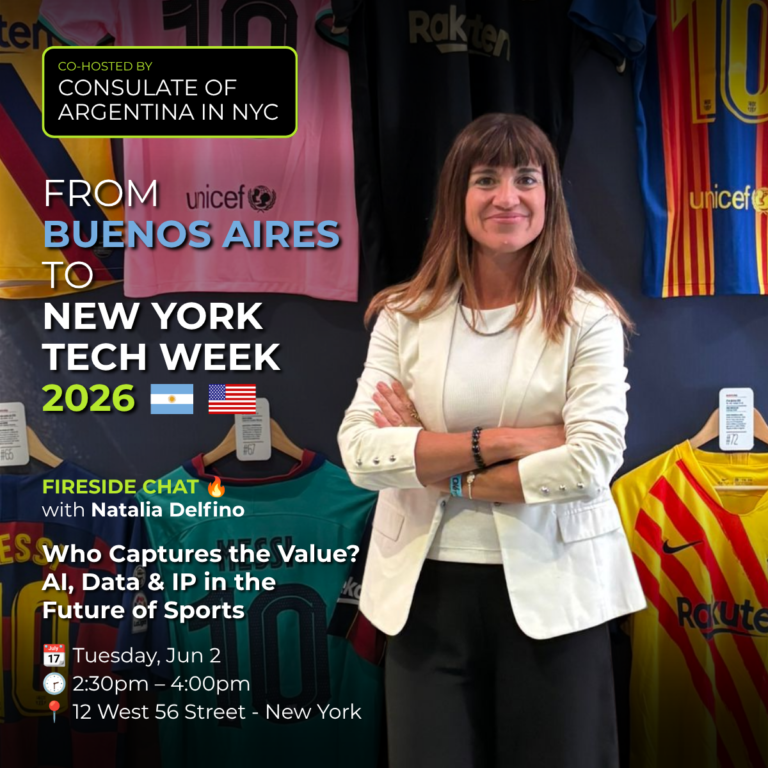
That was the central question behind Who Captures the Value? AI, Data & IP in the Future of Sports, a session held during NY Tech Week, bringing together professionals from technology, investment, law, artificial intelligence, and sports.
The discussion revealed several signals that are highly relevant not only to the future of SportsTech, but also to the digital transformation of many other industries.
From Physical Sport to a Data Economy
For decades, the main assets of the sports industry were relatively visible: players, stadiums, broadcasting rights, sponsors, infrastructure, and audiences.
Today, a second layer of value is emerging—one that is far less visible.
Every athlete generates data.
Every match generates information.
Every video contains performance signals.
Every digital interaction creates new variables.
And artificial intelligence makes it possible to process those signals at a scale that would have been impossible only a few years ago.
Sports are increasingly becoming an economy of intangible assets, where software, algorithms, databases, AI models, brands, reputation, and digital identity can become strategic assets.
The question is no longer simply who has the best players.
It is also who owns the data, who can interpret it, and who builds the infrastructure that turns it into decisions.
AI does not eliminate Expertise. It Expands its reach.
One of the most interesting debates surrounding AI in sports is the assumption that technology will replace human expertise.
The opposite may prove to be true.
In scouting, for example, a professional can only watch a limited number of players. AI can help filter thousands of profiles, identify patterns, organize information, and prioritize where human attention should be focused.
Technology expands the field of observation.
But interpretation still requires experience, context, and football knowledge.
The future is therefore unlikely to be AI versus scouts.
It will be:
human expertise + data + artificial intelligence.
This also introduces another critical issue: data quality.
An algorithm trained on incomplete, biased, or unreliable information simply amplifies those weaknesses.
That is why the next major technological race will not only be about building better AI models.
It will also be about building better data ecosystems.
The real Asset may be the Infrastructure
Many sports startups define themselves around a specific feature:
video analysis, performance measurement, player discovery, club management, or scouting automation.
However, the companies capable of creating the greatest long-term value may emerge elsewhere: among those able to become infrastructure.
Infrastructure for identity.
Infrastructure for data.
Infrastructure for trust.
Infrastructure for intelligence.
Infrastructure for opportunity.
We have already seen this evolution in other industries.
Some of the most valuable companies are not those producing the final asset. They are the ones building the layers that allow millions of actors to interact.
The same dynamic may now begin to reshape sports.
Intellectual Property moves back to the Center
If value is increasingly shifting toward intangible assets, intellectual property can no longer be treated as a peripheral legal matter.
It becomes part of business strategy.
Who owns the videos?
Who can use the data generated by an athlete?
Who owns a database?
What happens when that data is used to train an artificial intelligence model?
Who can commercialize the insights produced from that data?
Where do the rights of the platform end, and the rights of the athlete begin?
These questions will become increasingly important.
Especially because sports ecosystems often involve young athletes and minors, introducing additional issues related to privacy, consent, image rights, and data protection.
Trust itself may become one of the most valuable assets in the emerging sports economy.
Latin America has a particular Opportunity
This discussion has another dimension for our region.
Latin America has historically produced an extraordinary amount of football talent.
Yet much of the technology, digital platforms, data infrastructure, and systems used to organize and monetize that talent are developed elsewhere.
This creates a paradox.
The region can be one of the world’s greatest producers of talent while capturing only a relatively small share of the technological value created around it.
The next generation of Latin American SportsTech has an opportunity to change that equation.
Not only by exporting players.
But also by building:
software, data, artificial intelligence, intellectual property, and digital infrastructure.
This is also part of the thinking behind FutbolTalent.pro, an initiative developed within the Proxy innovation ecosystem to explore how digital identity, trusted data, and technology can expand access to football talent discovery.
The challenge is not simply to digitize scouting.
It is to ask what kind of infrastructure football will need in the future.
The Question that remains
Artificial intelligence will make information cheaper to produce.
Data will become more abundant.
Algorithms will become more powerful.
And precisely because of that, other assets will become increasingly valuable:
trust, identity, governance, intellectual property, and the ability to coordinate ecosystems.
The major question of the coming years will therefore not only be what artificial intelligence can do.
It will be:
Who builds the infrastructure, who controls the intangible assets, and who ultimately captures the value that technology creates?
For companies, startups, governments, and sports organizations, beginning to ask that question may be just as important as adopting the technology itself.
Proxy Innova
Technology · Innovation · Artificial Intelligence · Intellectual Property · Digital Transformation