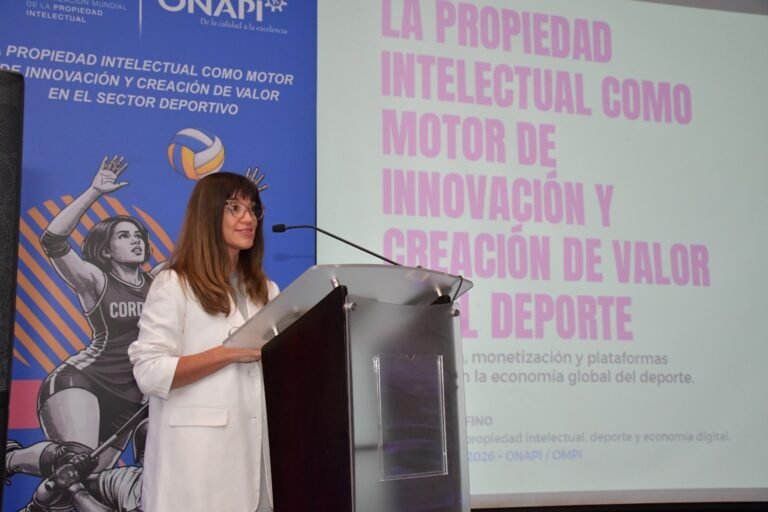

This year, I had the privilege of participating in the World Intellectual Property Day 2026 program in Santo Domingo, Dominican Republic, as an international keynote speaker, invited through the collaboration between the World Intellectual Property Organization (WIPO) and the National Office of Industrial Property (ONAPI).
The visit became much more than a conference. It evolved into a series of institutional dialogues, interviews and strategic conversations around one central question:
How can intellectual property become an engine for innovation, value creation and sustainable economic development in the sports industry?
Beyond Traditional Intellectual Property
Intellectual property is often associated with patents, trademarks or copyright protection. While these remain fundamental, today’s innovation economy demands a broader perspective.
Modern sports ecosystems generate an extraordinary variety of intangible assets:
- athlete identity and personal brands;
- image rights;
- performance and biometric data;
- digital platforms;
- audiovisual content;
- artificial intelligence applications;
- software and algorithms;
- scouting methodologies;
- community engagement;
- reputation and trust.
The challenge is no longer simply protecting these assets. The challenge is designing ecosystems capable of identifying, governing and capturing the value they generate.
A Strategic Conversation for Latin America
During my keynote, “Intellectual Property as a Driver of Innovation and Value Creation in Sports,” we explored how intellectual property can serve as strategic infrastructure for countries seeking to strengthen their sports industries.
Rather than viewing IP as an isolated legal discipline, we discussed its role as a framework connecting innovation, entrepreneurship, digital transformation and economic development.
Sports are increasingly becoming data-driven ecosystems where technology, AI and digital platforms reshape how talent is discovered, developed and commercialized.
Countries that recognize this transformation early will be better positioned to retain value, foster innovation and create sustainable opportunities for athletes, clubs and entrepreneurs.
Dialogue with the Dominican Baseball Ecosystem
One of the highlights of the mission was participating in a strategic dialogue with representatives of the Dominican National Baseball Commission.
Baseball represents one of the Dominican Republic’s most valuable cultural and economic assets. The conversation focused on the opportunities to strengthen the ecosystem through intellectual property, innovation and digital transformation.
Topics included:
- governance of sports data;
- athlete image rights;
- digital identity;
- technology platforms;
- AI-enabled talent development;
- innovation ecosystems;
- long-term value creation.
Rather than discussing isolated technologies, the dialogue emphasized how public institutions, sports organizations and private innovators can collaborate to create more resilient and competitive sports ecosystems.
Continuing the Conversation
The ideas explored in Santo Domingo continued shortly afterward during New York Tech Week, where I hosted the fireside chat “Who Captures the Value? AI, Intellectual Property and the Future of Sports Talent Economies” at the Argentine Consulate in New York.
Although developed in different contexts, both conversations converged around the same fundamental question:
Who owns, governs and ultimately captures the value created by sports talent in an increasingly digital economy?
This question extends beyond sports. It reflects broader challenges facing governments, startups, technology companies and innovation ecosystems across emerging economies.
Looking Ahead
The experience in the Dominican Republic reaffirmed something I have increasingly observed across international projects:
Innovation is no longer driven solely by technology.
It is driven by our ability to design governance models capable of transforming knowledge, creativity, data and talent into sustainable economic value.
For sports ecosystems, intellectual property is becoming far more than a legal mechanism—it is emerging as strategic infrastructure for innovation, competitiveness and long-term development.
As artificial intelligence, digital platforms and data continue to reshape industries, the opportunity is not simply to protect innovation, but to build ecosystems that enable innovation to generate lasting value for society.
Acknowledgements
I would like to express my sincere gratitude to the World Intellectual Property Organization (WIPO) and the National Office of Industrial Property (ONAPI) for the invitation and for creating a space where these conversations could take place.
Special thanks to the Dominican institutions and professionals who generously shared their perspectives and contributed to a rich exchange of ideas on the future of intellectual property, innovation and sports.